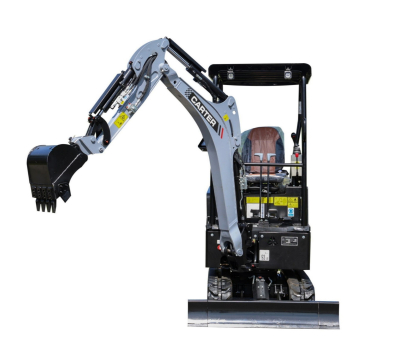
0.6 T Compact Excavator
Manufacturing Process
Steel Cutting & Forming: CNC plasma and bending equipment prepare high-strength plates.
Welding Assembly: Robotic and manual welding create the boom, arm, frame, and chassis.
Machining: Critical pinholes, bushings, and cylinder mounts undergo CNC precision machining.
Hydraulic Integration: Pumps, valves, cylinders, and hoses assembled under clean-room standards.
Power Unit Installation: Engine mounting, fuel system integration, and electrical routing.
Painting Process: Sandblasting, primer, and polyurethane coating for corrosion resistance.
Final Testing: Load tests, hydraulic pressure checks, control calibration, and stability inspections.
Definition of 0.6 T Compact Excavator
The 0.6-ton compact excavator is a micro hydraulic digging machine, engineered for earthmoving and light construction in tight spaces. Its applications include residential landscaping, utility trenching, and similar tasks. Combining precise control with low operating costs and efficient power output, it meets the needs of contractors, distributors, and engineering procurement teams.
Technical Specifications
| Parameter | Value |
|---|---|
| Operating Weight | 600–680 kg |
| Engine Power | 7–10.2 kW (Gasoline or Diesel) |
| Bucket Capacity | 0.015–0.02 m³ |
| Max Digging Depth | 1100–1450 mm |
| Max Dumping Height | 1500–1850 mm |
| Hydraulic System Pressure | 14–18 MPa |
| Travel Speed | 1.4–2.0 km/h |
| Track Type | Rubber Track (150–180 mm width) |
| Overall Size | 2200–2600 × 900–1100 × 2200 mm |
Structure and Material Composition
Upper Frame: Welded steel structure for engine, pump, and control layout.
Boom & Arm: Q345B or ST52 high-strength steel plates with full-length reinforcement ribs.
Undercarriage: Rubber tracks, track rollers, tensioning system, steel drive sprockets.
Hydraulic System: Gear pump or piston pump, multi-way valves, cylinders, auxiliary lines.
Operator Station: Mechanical levers, adjustable seat, ROPS optional.
Electrical System: 12V harness, starter, safety relays, work lights.
Manufacturing Process
Steel Cutting & Forming: CNC plasma and bending equipment prepare high-strength plates.
Welding Assembly: Robotic and manual welding create the boom, arm, frame, and chassis.
Machining: Critical pinholes, bushings, and cylinder mounts undergo CNC precision machining.
Hydraulic Integration: Pumps, valves, cylinders, and hoses assembled under clean-room standards.
Power Unit Installation: Engine mounting, fuel system integration, and electrical routing.
Painting Process: Sandblasting, primer, and polyurethane coating for corrosion resistance.
Final Testing: Load tests, hydraulic pressure checks, control calibration, and stability inspections.
Industry Comparison
| Type | 0.6 T Compact Excavator | 1.0 T Mini Excavator | Manual Labor |
|---|---|---|---|
| Digging Depth | 1.1–1.45 m | 1.6–1.9 m | 0.3–0.5 m |
| Fuel/Energy Cost | Low | Medium | N/A |
| Operational Efficiency | High in small spaces | High | Very low |
| Maintenance Cost | Very low | Low | N/A |
| Application | Confined jobs | General sites | Tiny manual tasks |
Application Scenarios
Residential construction and landscaping.
Utility trenching for water, gas, and electrical pipelines.
Agricultural site maintenance and ditch clearing.
Indoor and basement excavation, foundation adjustments.
Small demolition, stump removal, and soil relocation tasks.
Core Pain Points & Engineering Solutions
Limited working space: The 0.6 T compact excavator features a narrow chassis (≤1100 mm) for effective indoor and tight-area operation.
High fuel cost: Small-displacement engines maintain low consumption while providing stable power.
Operator fatigue: Mechanically optimized control levers reduce the force required for multi-directional movement.
Maintenance downtime: Standardized hydraulic components shorten service cycles and simplify parts replacement.
Risk Warnings & Mitigation
Overloading leads to boom deformation—operate within rated load limits.
Inferior hydraulic oil accelerates pump wear—use ISO VG46 or recommended grades.
Unstable ground may cause tilting—deploy blade support and follow slope restrictions.
Unauthorized modifications impact warranty—use certified attachments only.
Procurement & Selection Guide
Confirm operating weight (600–680 kg) required for your jobsite conditions.
Check engine brand, emission compliance, and fuel type.
Assess hydraulic pump type (gear vs piston) based on duty cycle.
Evaluate boom material thickness and reinforcement design.
Inspect track width and undercarriage durability.
Verify availability of attachments: auger, ripper, rake, breaker.
Review spare parts supply and after-sales response time.
Request load test videos and factory inspection reports.
Real Engineering Case
A municipal landscaping contractor utilized 0.6 T compact excavators for trenching fiber-optic conduits across narrow residential pathways. The machines completed 1.2 km of trenching with a digging depth of 1.3 m, reducing labor cost by 48% and shortening project time by 32% due to improved maneuverability and low-fuel operation.
FAQ
What is the typical fuel consumption? 0.8–1.2 L per hour.
Can it be transported in a pickup? Yes, most units fit in standard 1-ton pickups.
Is hydraulic flow sufficient for breakers? Yes, with 18–22 L/min models.
What is the track lifetime? 800–1200 hours under normal terrain.
Does it support quick couplers? Optional mechanical couplers available.
Can beginners operate it? Yes, mechanical joystick layout is simple.
Recommended hydraulic oil? ISO VG46 in normal climate.
Maintenance interval? 250 hours for engine and hydraulic system.
Can it work indoors? Yes, especially gasoline versions with proper ventilation.
Noise level? 78–85 dB depending on engine type.
Request Quotation / Technical Files / Samples
For pricing, engineering drawings, hydraulic diagrams, or sample evaluation units, please contact our technical sales team. Detailed BOM, performance curves, and compatibility charts are available upon request.
E-E-A-T Author Credentials
This article is prepared by a construction machinery technical consultant with over 12 years of experience in micro-excavator engineering design, hydraulic system integration, and equipment sourcing for EPC contractors and global distributors.


Mini Excavator Attachment:

Mini Excavator Package&shipment:
Our skilled loading and logistics group ensures speedy and impenetrable shipping of excavators to clients worldwide. We provide numerous transportation options, together with general containers, bulk shipping, and rail freight.