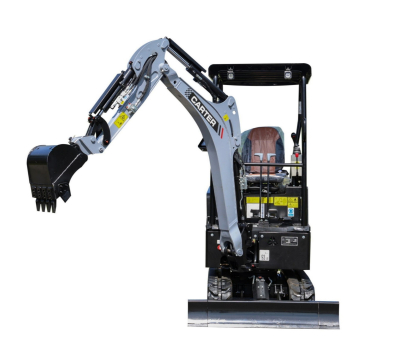
1 Ton Crawler Excavator
Manufacturing Process
Material Preparation: cutting steel plates using CNC plasma/laser equipment to ensure precise tolerances.
Welding & Fabrication: robotic welding for boom and chassis to ensure uniform penetration and fatigue resistance.
Machining: pivot points, pin bores and valve mounts processed on CNC machining centers.
Hydraulic Assembly: pump installation, valve block routing and pressure calibration.
Undercarriage Assembly: track motors, rollers, sprockets and tensioning system alignment.
Painting & Coating: primer + topcoat with minimum 480 hr corrosion resistance.
Final Inspection: digging cycle test, swing torque testing, noise check and leak-off measurement.
Definition of 1 Ton Crawler Excavator
The 1 Ton Crawler Excavator is a compact earthmoving machine equipped with rubber tracks and an approximate operating weight of 1,000 kg. Suited for light-duty tasks such as excavation, trenching, landscaping, and utility projects, it is designed to operate effectively in confined spaces and on surfaces requiring low ground pressure.
Technical Specifications
| Item | Specification |
|---|---|
| Operating Weight | 950–1,050 kg |
| Engine Power | 7–10 kW (Diesel, EPA Tier 4 / Stage V) |
| Bucket Capacity | 0.02–0.03 m³ |
| Max Digging Depth | 1,600–1,900 mm |
| Max Reach | 2,800–3,100 mm |
| Track Width | 150–180 mm (Rubber Track) |
| Hydraulic Pump Flow | 16–20 L/min |
| Working Pressure | 16–18 MPa |
| Travel Speed | 1.5–2.5 km/h |
| Overall Width | 900–1,000 mm |
Structure and Material Composition
Upper Frame: engine bay, control platform, hydraulic pump chamber, counterweight.
Undercarriage: rubber tracks, travel motors, rollers, sprocket assemblies, adjustable tensioner.
Front Workgroup: boom, arm, bucket, linkages and optional quick coupler.
Hydraulics: gear pump, main control valve, swing motor, auxiliary lines for attachments.
Operator Controls: mechanical levers or pilot hydraulic joysticks.
Materials: Q235/Q345 steel structure, reinforced rubber tracks, high-strength pin shafts, NBR/FKM seals.
Manufacturing Process
Material Preparation: cutting steel plates using CNC plasma/laser equipment to ensure precise tolerances.
Welding & Fabrication: robotic welding for boom and chassis to ensure uniform penetration and fatigue resistance.
Machining: pivot points, pin bores and valve mounts processed on CNC machining centers.
Hydraulic Assembly: pump installation, valve block routing and pressure calibration.
Undercarriage Assembly: track motors, rollers, sprockets and tensioning system alignment.
Painting & Coating: primer + topcoat with minimum 480 hr corrosion resistance.
Final Inspection: digging cycle test, swing torque testing, noise check and leak-off measurement.
Industry Comparison
| Category | 1 Ton Crawler Excavator | 0.8 Ton Micro Excavator | 1.6 Ton Mini Excavator |
|---|---|---|---|
| Digging Power | Light-duty | Very light-duty | Medium-duty |
| Transport | Pickup trailer | Easy, smallest | Requires larger trailer |
| Width | 0.9–1.0 m | 0.65–0.8 m | 1.0–1.1 m |
| Applications | Landscaping, utilities | Indoor & farm use | Construction & rental |
| Investment Level | Low | Lowest | Medium |
Application Scenarios
Distributors: suitable for entry-level equipment portfolios with high rental turnover.
EPC Contractors: trenching for electrical/communication ducts in restricted areas.
General Construction: small foundations, drainage, repair works.
Landscaping: planting, soil movement, backyard excavation.
Agricultural Users: irrigation line digging, stable cleaning, small utility works.
Core Pain Points and Engineering Solutions
Insufficient digging torque in compact engines.
Solution: optimized hydraulic spool design and higher pump flow for improved breakout performance.Narrow tracks causing instability on uneven surfaces.
Solution: reinforced undercarriage frame and optional extended track stance.High wear rate of pins and bushings.
Solution: heat-treated 42CrMo pins with self-lubricating bush sets.Hydraulic overheating under long continuous duty.
Solution: larger oil tank volume and optimized hose routing to reduce pressure loss.
Risk Warnings and Mitigation
Avoid deep trench operation without proper shoring to prevent collapse hazards.
Ensure load limits are respected; overreaching with a full bucket increases tipping risk.
Do not use the boom/arm to push or tow heavy objects; structural fatigue may occur.
Conduct daily leak inspections; small leaks can lead to hydraulic cavitation failures.
Procurement & Selection Guide
Define job requirements: trench depth, soil hardness, daily operating hours.
Check compliance with local emission standards (EPA Tier 4 / Stage V / Non-certified).
Compare hydraulic pump flow, brand and valve quality.
Inspect undercarriage robustness: track material, roller design, tension system.
Verify attachment compatibility (breaker, auger, rake, quick hitch).
Evaluate serviceability: access covers, filter placement, lubrication points.
Review supplier warranty terms and parts availability.
Confirm structural steel thickness—particularly boom/arm main plates and chassis beams.
Engineering Case Study
During a residential fiber-optic installation project, a 1 Ton Crawler Excavator was deployed to dig 400–600 mm deep cable trenches along a 1.5 m-wide corridor. The machine achieved 120–150 meters of trench per day due to its compact width and low ground disturbance, allowing uninterrupted pedestrian access. The project completion time was reduced by 38% compared to manual excavation, with documented fuel consumption averaging 0.8–1.2 L/h.
FAQ
What is the standard gasoline consumption?
Approximately 0.8–1.3 L/h relying on load.
Can it be transported in a small trailer?
Yes, most 1 Ton Crawler Excavators match wellknown pickup trailers.
Is it appropriate for indoor demolition?
Yes, however appropriate air flow and low-noise attachments are recommended.
Does it guide hydraulic breakers?
Yes, 50–65 mm category breakers are compatible.
What is the protection cycle?
Engine oil each 250 hours; hydraulic oil each 500–600 hours.
Can it function on slopes?
Safe operation up to 15°; past this requires caution.
Are rubber tracks durable?
Reinforced tracks generally final 500–800 working hours.
What bucket sizes are available?
200–400 mm buckets for trenching and normal work.
Does it help speedy couplers?
Mechanical and hydraulic selections available.
Is it advocated for condo fleets?
Yes, due to low cost, excessive utilization and small transport footprint
Request Technical Documents or Quotation (CTA)
To receive engineering drawings, performance data, or a formal quotation for the 1 Ton Crawler Excavator, please submit your company details, operating requirements and project scope. A technical consultant will respond within one business day.
Author Credentials (E-E-A-T)
The article is prepared by a construction machinery consultant with over a decade of experience in mini excavator design evaluation, procurement auditing and job-site performance analysis for EPC contractors, rental companies and import distributors.


Mini Excavator Attachment: