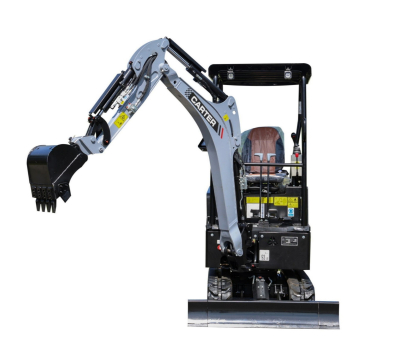
Zero Tail 1.2 Ton Excavator
Structure and Material Composition
Upper Frame: High-strength low-alloy steel with reinforcement plates.
Boom and Arm: Welded box-section steel, stress-relieved to prevent fatigue cracks.
Undercarriage: Rubber track assembly with forged sprocket and hardened rollers.
Hydraulic System: Gear or piston pump, load-sensitive valves, high-pressure hoses.
Rotary System: Slew bearing with reduction gearbox.
Cab/ROPS: Open canopy or enclosed cab with operator protection structure.
Control System: Mechanical joysticks or pilot-assisted hydraulic control.
Accessories: Buckets, augers, breakers, rippers, trenchers, grabbers.
Product Definition
The 1.2 ton excavator is a compact hydraulic machine designed for light-to-medium earthmoving tasks in construction, landscaping, municipal maintenance, and agricultural applications. It provides efficient digging performance in confined areas while maintaining transport convenience and low operating costs.
Technical Parameters and Specifications
Operating Weight: 1,150–1,250 kg
Engine Power: 8–15 kW (diesel, Stage V/EPA Tier 4 compliant)
Bucket Capacity: 0.025–0.035 m³
Max Digging Depth: 1,650–2,000 mm
Max Digging Radius: 3,000–3,500 mm
Hydraulic Flow: 18–28 L/min
Travel Speed: 2.0–4.0 km/h
Gradeability: 25–30°
Track Type: Rubber track 180–230 mm width
Overall Width: 900–1,100 mm
Fuel Tank Capacity: 15–25 L
Auxiliary Hydraulic Line: Standard single-way/dual-way circuit
Structure and Material Composition
Upper Frame: High-strength low-alloy steel with reinforcement plates.
Boom and Arm: Welded box-section steel, stress-relieved to prevent fatigue cracks.
Undercarriage: Rubber track assembly with forged sprocket and hardened rollers.
Hydraulic System: Gear or piston pump, load-sensitive valves, high-pressure hoses.
Rotary System: Slew bearing with reduction gearbox.
Cab/ROPS: Open canopy or enclosed cab with operator protection structure.
Control System: Mechanical joysticks or pilot-assisted hydraulic control.
Accessories: Buckets, augers, breakers, rippers, trenchers, grabbers.
Manufacturing Process
Step-by-Step Engineering Workflow
Steel Cutting: CNC laser/plasma cutting for structural components.
Welding: Robotic MIG welding ensures stable joints and fatigue resistance.
Heat Treatment: Stress-relief processing of boom/arm assemblies.
Machining: Precision boring and milling of hinge points and bearing seats.
Painting: Shot blasting + epoxy primer + polyurethane topcoat.
Hydraulic Installation: Pump, valves, cylinders, and hoses assembled with pressure testing.
Electrical System: Wiring harness installation and function calibration.
Final Assembly: Track frame, upper structure, counterweight, canopy.
Testing: Load test, travel test, hydraulic leakage test, noise/vibration inspection.
Key Production Equipment
Robotic welding stations
CNC machining centers
Hydraulic pressure testing benches
Paint booth with automated drying line
Endurance-test platforms
Critical Quality Control Points
Hydraulic cylinder sealing and pressure retention
Weld penetration depth ≥ 85%
Boom/arm geometric alignment (tolerance ±0.5 mm)
Track tension and rolling resistance testing
Engine emission compliance verification
Industry Comparison
| Machine Type | Operating Weight | Digging Depth | Cost | Main Application |
|---|---|---|---|---|
| 1.2 Ton Excavator | 1.1–1.3 t | 1.6–2.0 m | Low | Urban, landscaping, property maintenance |
| Mini Skid Steer | 1.0–1.5 t | N/A | Medium | Attachment-based multi-purpose |
| 2 Ton Excavator | 1.8–2.2 t | 2.2–2.6 m | Higher | Commercial construction |
| Backhoe Loader | 3–8 t | 3–4 m | High | Rural/municipal works |
Application Scenarios
Landscaping and garden maintenance
Urban infrastructure foundation trenching
Pipeline installation and cable laying
Indoor demolition and confined-space operations
Agricultural land preparation and orchard maintenance
Municipal repair and drainage works
Small-scale construction and real estate projects
Core Pain Points & Engineering Solutions
Limited engine torque in small machines: Upgraded hydraulic pump and optimized valve matching improve digging efficiency.
Track wear in urban surfaces: Reinforced rubber track formula increases lifespan by 15–25%.
Overheating during long operations: Enhanced cooling module with larger core and optimized airflow.
Hydraulic leakage risks: High-pressure hose routing design and sealed connectors prevent early failure.
Operator fatigue: Pilot-assisted joysticks and suspended seat reduce vibration exposure.
Risk Warnings & Mitigation Suggestions
Avoid overloading the boom; exceeding rated digging force may cause structural fatigue.
Perform daily grease lubrication for hinge points to prevent premature wear.
Operate only on stable ground; small machines have limited counterweight balance.
Use correct hydraulic attachments; mismatched flow can damage seals and valves.
Store indoors to avoid long-term UV exposure on rubber components.
Procurement and Selection Guide
Define expected digging depth and operating radius.
Check engine brand, emission compliance, and fuel consumption rate.
Evaluate hydraulic system capacity (pump flow, pressure, valve type).
Compare boom/arm structure thickness and welding quality.
Inspect track frame quality, roller strength, and ground clearance.
Confirm auxiliary hydraulic line specifications for attachments.
Review test reports and QC records provided by the manufacturer.
Assess spare parts availability and after-sales support.
Engineering Case Study
Urban Residential Foundation Project – Europe (2024)
A contractor used ten 1.2 ton excavators for narrow-area trenching in a residential district. With a 1,850 mm digging depth and compact 980 mm width, the machines reduced excavation time by 32% compared to larger units. Fuel consumption decreased by 18%, and transport logistics were simplified, enabling rapid multi-site deployment.
FAQ
Main advantages? Compact size, low fuel cost, flexible operation.
Typical service life? 6–10 years with proper maintenance.
Is a 1.2 ton excavator suitable for rocky soil? Only for light-duty operations.
Compatible attachments? Buckets, breakers, augers, rippers, grabbers.
Daily maintenance items? Greasing, fuel check, track tension, hydraulic inspection.
Transport method? Small trailer or pickup platform.
Fuel type? Diesel, Stage V/Tier 4 compliant engines.
How deep can it dig? 1.6–2.0 m depending on model.
Can it operate indoors? Yes, with proper ventilation.
Recommended hydraulic oil? ISO VG 46 or OEM-specified grade.
Request a Quote or Technical Documents
Construction buyers, importers, and contractors may request detailed specifications, drawings, test reports, and machine samples by submitting project requirements, intended application, and annual purchasing volume.
E-E-A-T Author Credentials
This content is prepared by a senior construction machinery engineering consultant with over 12 years of experience in compact excavator design, hydraulic system optimization, and multi-regional construction project deployment.


Mini Excavator Package&shipment:
Mini excavators can be delivered quickly and securely across the globe thanks to our expert loading and logistics team, with available transport options like standard containers, bulk freight, and rail lines.