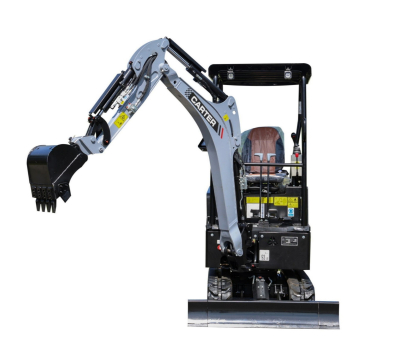
1.6 Ton Mini Excavator
Manufacturing Process
Steel Cutting: laser or plasma cutting for boom, chassis and frame components to ensure dimensional accuracy.
Welding Assembly: robotic welding for boom and undercarriage structures to improve weld consistency.
CNC Machining: pivot points, ear plates, swing bearing mounts processed by precision CNC equipment.
Hydraulic Assembly: pump installation, valve block assembly and line pressure testing.
Surface Treatment: sandblasting, primer coating, and topcoat painting, with 720+ hr salt-spray performance.
Final Testing: verification of digging motions, swing leakage, travel speed and engine load performance.
Definition of 1.6 Ton Mini Excavator
A 1.6 Ton Mini Excavator is a compact crawler excavator with an operating weight of around 1,600 kg, designed for light to medium-duty earthmoving tasks in construction, landscaping, municipal maintenance and utility trenching.
Technical Specifications
| Item | Specification |
|---|---|
| Operating Weight | 1,550–1,650 kg |
| Engine Power | 10–15 kW (Diesel, EPA Tier 4 / EU Stage V) |
| Bucket Capacity | 0.03–0.05 m³ |
| Max Digging Depth | 2,100–2,300 mm |
| Max Reach | 3,600–3,800 mm |
| Transport Length | 3,500–3,650 mm |
| Track Width | 180–230 mm (Rubber Track) |
| Hydraulic Pump Flow | 18–28 L/min |
| Working Pressure | 18–22 MPa |
Structure and Material Composition
Upper Structure: swing frame, hydraulic pump compartment, engine bay, operator station.
Undercarriage: drive motors, track rollers, rubber tracks, tensioning mechanism.
Working Equipment: boom, arm, bucket, optional quick coupler.
Hydraulic System: gear/variable pump, main control valve, swing motor, pilot control lines.
Control System: mechanical pilot or electro-proportional operation.
Materials: Q345 structural steel, wear-resistant plates, reinforced rubber track, NBR/FKM hydraulic seals.
Manufacturing Process
Steel Cutting: laser or plasma cutting for boom, chassis and frame components to ensure dimensional accuracy.
Welding Assembly: robotic welding for boom and undercarriage structures to improve weld consistency.
CNC Machining: pivot points, ear plates, swing bearing mounts processed by precision CNC equipment.
Hydraulic Assembly: pump installation, valve block assembly and line pressure testing.
Surface Treatment: sandblasting, primer coating, and topcoat painting, with 720+ hr salt-spray performance.
Final Testing: verification of digging motions, swing leakage, travel speed and engine load performance.
Industry Comparison
| Category | 1.6 Ton Mini Excavator | 1 Ton Mini Excavator | 2 Ton Mini Excavator |
|---|---|---|---|
| Excavation Capability | Balanced, multi-scenario | Light-duty tasks | Higher productivity |
| Transport Convenience | Fits on pickup trailer | Easiest to transport | Requires light truck |
| Investment Level | Medium | Lowest | Higher |
| Target Users | Contractors, EPC, rental | Farm users, homeowners | Construction & rental fleets |
Application Scenarios
Construction contractors: trenching, footing excavation in narrow spaces.
EPC project teams: solar plant foundations, utility pipeline works.
Landscaping companies: tree-pit digging, grading and site shaping.
Rental companies: high turnover, small job-site dispatching.
Agricultural and ranch operations: drainage works, shed installation, water lines.
Core Pain Points and Solutions
Pain Point 1: Insufficient stability on uneven ground.
Solution: widened undercarriage and reinforced arm structure to reduce lateral sway.Pain Point 2: Hydraulic response not smooth.
Solution: high-flow gear pump with optimized valve spool configuration for better fine control.Pain Point 3: Fast wear of rubber tracks.
Solution: multi-layer reinforced tracks with increased steel core density.Pain Point 4: High fuel consumption and difficult maintenance.
Solution: low-RPM diesel engine and side-opening service covers for quick daily checks.
Risk Warnings and Mitigation
Avoid full-load excavation on slopes above 25°; site leveling is required.
Do not run at continuous maximum pump pressure to prevent hydraulic overheating.
Urban operations must meet noise regulations; confirm low-noise exhaust setup.
During transport, ensure swing lock engagement and arm retraction.
Procurement & Selection Guide
Define job requirements (trench depth, soil type, duty cycle).
Confirm engine emission standards (EU Stage V / EPA Tier 4 / non-road markets).
Compare pump flow, valve brand and swing bearing design.
Check undercarriage dimensions, track durability and tensioning type.
Review attachment compatibility (breaker, auger, grapple, quick coupler).
Evaluate parts availability and after-sales service coverage.
Adjust configuration based on budget (wider tracks, canopy, auxiliary hydraulics).
Engineering Case Study
In a municipal drainage trench project, a 1.6 Ton Mini Excavator was used to complete 1.8 km of pipeline trenching. Working within a 2.2-meter pedestrian zone, the machine equipped with a 300 mm bucket achieved a consistent digging depth of 2.1 m and delivered 22–28 meters of trench per hour. The project duration was reduced by 62% compared with manual excavation, with machine availability reaching 93%.
FAQ
What is the fuel consumption? Typically 1–1.8 L/h.
Can it work with a breaker? Yes, 68–75 mm breakers are compatible.
Is a flatbed truck required for transport? A pickup trailer is sufficient.
Hydraulic oil replacement interval? 500–800 operating hours.
Suitable for indoor demolition? Yes, with proper ventilation and rubber tracks.
Max operating altitude? 2,500–3,000 m depending on engine model.
Does it support quick couplers? Both mechanical and hydraulic types are optional.
Cold-weather performance? Recommended for −15°C and above.
Is daily maintenance complicated? Side-open covers allow quick inspection.
Is it suitable for rental companies? Yes, due to high utilization and low maintenance needs.
Request Technical Documents or Quotation (CTA)
For engineering samples, detailed specifications or a formal quotation for the 1.6 Ton Mini Excavator, please submit your company information and project requirements. Our technical team will respond within 24 hours.
Author Credentials (E-E-A-T)
This article is written by a technical advisor with over 10 years of experience in construction machinery selection, hydraulic system commissioning and international project delivery. The content reflects real project data and engineering best practices.


📍Inquire Now (CARTER Button):
📞 Call/WeChat +86 15064983182 | 📧ct008@carter.cn | 🤙WhatsApp +86 15064983182